Squatters' Rights in New York: A Property Owner's Guide (2026)
Landlord & Owner Protection · New York
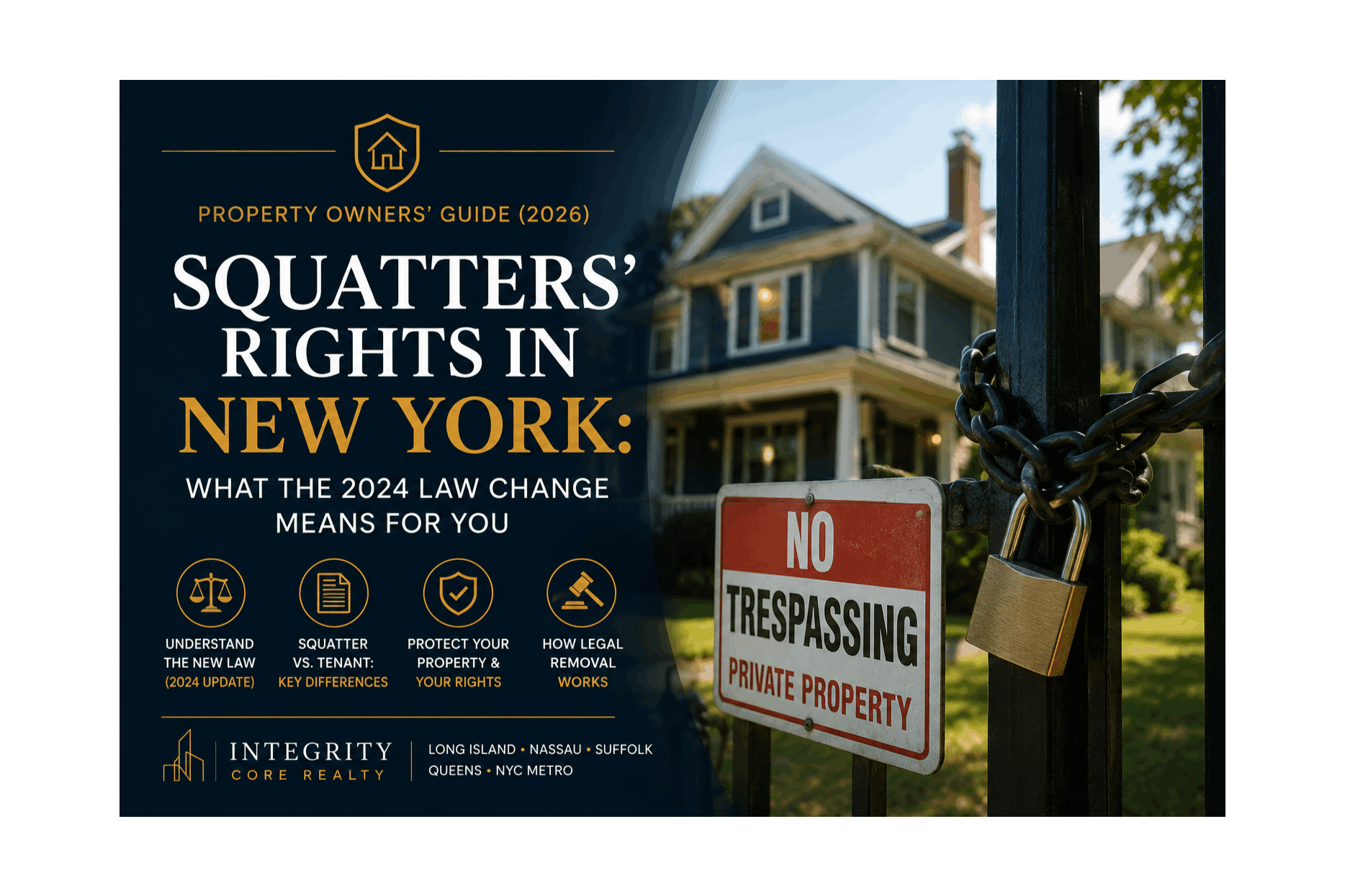
Squatters' Rights in New York: A Property Owner's Guide (2026)
Integrity Core Realty · Long Island · Nassau · Suffolk · Queens · NYC Metro · 8 min read
If you own a rental, a vacant lot, or a home you've inherited, you've probably heard the horror stories. An owner locked out of a house they hold the deed to. A family buried in legal fees over someone who never paid a dime. The good news is that New York changed its squatter law in 2024, and it moved in owners' favor. The catch is that the law on paper and the reality on your street aren't always the same thing. Here's what actually protects you.
What New York law says now: the 2024 change
For years, New York property owners operated under a stubborn piece of conventional wisdom. Let someone stay 30 days, the thinking went, and they become a "tenant" with full housing court protections, no lease required. That belief is what put homeowners on the wrong side of the law for trying to reclaim their own property.
In April 2024, New York's state budget addressed it directly. The law now states plainly that "a tenant shall not include a squatter," and it defines a squatter as someone who enters and occupies a property without the owner's permission and with no title, lease, or legal right to be there. Most importantly, no length of occupancy turns a squatter into a tenant. Thirty days, ninety days, it no longer converts an unlawful occupant into a protected renter.
On paper, that's a real shift. It gives police a basis to treat squatting as what it is, unlawful occupancy, rather than waving it off as a private "landlord tenant matter" they can't touch.
Law on paper versus reality on the ground
Here's the honest part, because you deserve the real picture and not a victory lap. A definition in the budget doesn't instantly fix how every situation plays out. Police response still varies by precinct and by how convincing your paperwork is. A determined occupant can still claim they had permission, produce a fake lease, or otherwise turn a clear case of trespass into a "disputed" one. Once it's disputed, you're often headed to court anyway, which can take weeks or longer.
So treat the 2024 law as a strong tool, not a magic wand. The owners who come through these situations fastest are the ones who documented everything, acted early, and never tried to take matters into their own hands.
How a squatter must legally be removed
This is the lesson behind every one of those viral cases, including the Queens homeowner arrested outside her own house: do not attempt to remove an occupant yourself. In New York, "self-help" eviction, meaning changing the locks, shutting off utilities, removing belongings, or forcing someone out, is a crime, and it can expose you to jail time and steep civil penalties even when the person inside has no right to be there.
The legal path looks like this:
- Call the police and bring proof. Your deed, recent tax bills, and any evidence the person entered without permission. Under the 2024 law, this is where you make the case that it's unlawful occupancy and not a tenancy.
- If it's contested, go through the court. That typically means a proceeding under New York's real property law, starting with proper written notice and, if the occupant stays, a petition to the court.
- Let a marshal or sheriff carry it out. Only after you have a court order for possession can an occupant be lawfully removed, and only by law enforcement, never by you.
We broke down how badly this can go when owners wait or improvise in our look at the Hulu docuseries, worth reading if you haven't: The Hulu Squatters Series Is a Wake-Up Call for Every NY Landlord.
What about adverse possession?
This is the fear that keeps owners up at night, that someone can simply live in your property long enough to own it. In New York it's far harder than the myth suggests. An adverse possession claim requires occupying the property openly, exclusively, and continuously for at least 10 years, along with a genuine "claim of right," meaning a reasonable belief they were entitled to it, a standard New York tightened in 2008. Casual squatting doesn't come close.
The practical takeaway isn't panic. It's monitoring. Adverse possession only becomes a threat to a property nobody is watching, which is exactly why the next section matters most.
Why vacant and inherited homes are the biggest targets
Occupied homes rarely get taken over. Empty ones do. A rental between tenants, a seasonal property, and above all a home moving slowly through estate or probate are the classic targets. No one is checking on them, mail piles up, and an occupant can settle in before anyone notices. If you're an executor or an heir managing a loved one's house, that quiet, in between period is precisely when the property is most exposed.
How to protect your property before there's a problem
Prevention is cheaper, faster, and far less stressful than removal. If you own anything that sits empty for stretches, build these habits now:
- Put cameras on the house, front and back. Install security cameras like Ring at both the front and rear of the property. This one matters more than people realize. If someone does break in, that footage becomes powerful evidence that they entered unlawfully, which is exactly what you need when you bring proof to the police under the 2024 law. It's the difference between "he said, she said" and a clear record of a break in.
- Change the locks and control every key. Any time a tenant moves out, or on any vacant or inherited property, rekey the locks immediately. Make sure no one outside a short list of trusted people has a copy. Uncontrolled keys are one of the most common ways an occupant later claims they were "let in."
- Check on it regularly, in person or through a trusted neighbor, property manager, or agent. Most takeovers succeed only because no one was looking.
- Make it look lived in and secured, with solid locks, lighting on timers, collected mail, and a maintained exterior. Visible attention is a deterrent.
- Sign up for a property fraud alert. Several New York county clerk offices, including on Long Island, offer free services that notify you if a document is recorded against your property. Check with the Nassau or Suffolk County Clerk for the exact program, and enroll for each property you own.
- Keep your paperwork airtight, including deed, title, tax records, and, for any rental, written agreements from day one. In a dispute, undocumented "permission" becomes the occupant's best weapon.
- Act within days, not weeks. The moment you learn someone is in a property they shouldn't be, start the legal process. Time only helps the occupant.
- Don't go public or go it alone. Call your attorney before posting online or confronting anyone. Both can backfire legally and escalate the situation.
When holding the property no longer makes sense
For some owners, especially landlords worn down by tenant complications, or families managing an empty inherited home from a distance, the smartest protection is simply not carrying the risk anymore. With Long Island values near record highs, plenty of owners are sitting on equity that makes a clean, strategic sale the better move than another year of exposure. We walked through one landlord's decade long ordeal here: A 10-Year Tenant Nightmare: What Every NY Landlord Must Know.
If you're weighing it, that's a conversation worth having before a problem forces your hand, not after.
Know Your Options Before You Need Them
We help owners across Long Island, Queens, Nassau, and the NYC metro protect their equity and, when it's the right call, exit cleanly. No pressure, just a clear look at where you stand.
Explore Your Landlord Exit Options Call (516) 200-1202Frequently Asked Questions
What rights do squatters have in New York in 2026?
Since New York's 2024 law change, a squatter is legally not a tenant, and no length of occupancy converts them into one. They do not gain a lease or rental protections simply by staying. However, they still cannot be forcibly removed by the owner. Removal must go through police and, if contested, the courts.
Is the "30-day rule" still true in New York?
No. The old belief that 30 days of occupancy earns tenant status was addressed by the 2024 budget law, which defines squatters as separate from tenants. In practice, though, an occupant who claims they had permission can still turn a case into a contested dispute, so acting quickly and documenting everything remains essential.
How do you legally remove a squatter in New York?
Never by self-help. Changing locks, removing belongings, or shutting off utilities is illegal and can lead to criminal charges. The lawful route is to involve police with proof of ownership and unauthorized entry, pursue a court proceeding if the occupant contests it, and have a marshal or sheriff carry out any removal under a court order.
Can a squatter really claim ownership of my property?
Only through adverse possession, which in New York requires open, exclusive, and continuous occupancy for at least 10 years plus a genuine claim of right. That's a high bar that rarely applies to ordinary squatting. Regularly monitoring any vacant property essentially eliminates this risk.
How can I protect a vacant or inherited home from being occupied?
Put security cameras on the front and back of the house so any break in is recorded, change the locks and limit keys to trusted people, check on the property often, keep it secured and looking lived in, enroll in your county clerk's property fraud alert, keep your deed and records in order, and act immediately if anyone moves in. Vacant and probate properties are the most common targets because no one is watching them.
This article is for general informational purposes only and does not constitute legal advice. New York squatter, tenant, and occupant laws vary by municipality and change over time, and enforcement can differ by locality. Always consult a licensed New York attorney before taking any action regarding a property occupancy dispute. Integrity Core Realty is a licensed real estate brokerage, not a law firm.
Categories
- All Blogs (63)
- Affordability (3)
- Buying Tips (9)
- Divorce & Real Estate (7)
- Downsizing & Senior Moves (3)
- Equity (3)
- Expired/Withdrawn/Canceled (1)
- Fairhaven Real Estate Stories (3)
- First-Time Buyers (8)
- For Buyers (32)
- For Sellers (21)
- Forecasts (3)
- Home Prices (3)
- Infographics (1)
- Mortgage Rates (2)
- NY/LI Landlord Resources (8)
- Pre-Foreclosure Options (2)
- Probate & Estate Home Sales (5)
- Rent vs. Buy (3)
- ⚖️ For Attorneys (4)
- 🏡 Featured Listings (20)
- 📍 Local Living (23)
- 📅 Open Houses & Events (3)
- 📊 Real Estate Insights (7)
Recent Posts