Does Good Cause Eviction Apply on Long Island? 2026 Guide | Integrity Core Realty
Landlord Exit Strategy · New York & Long Island
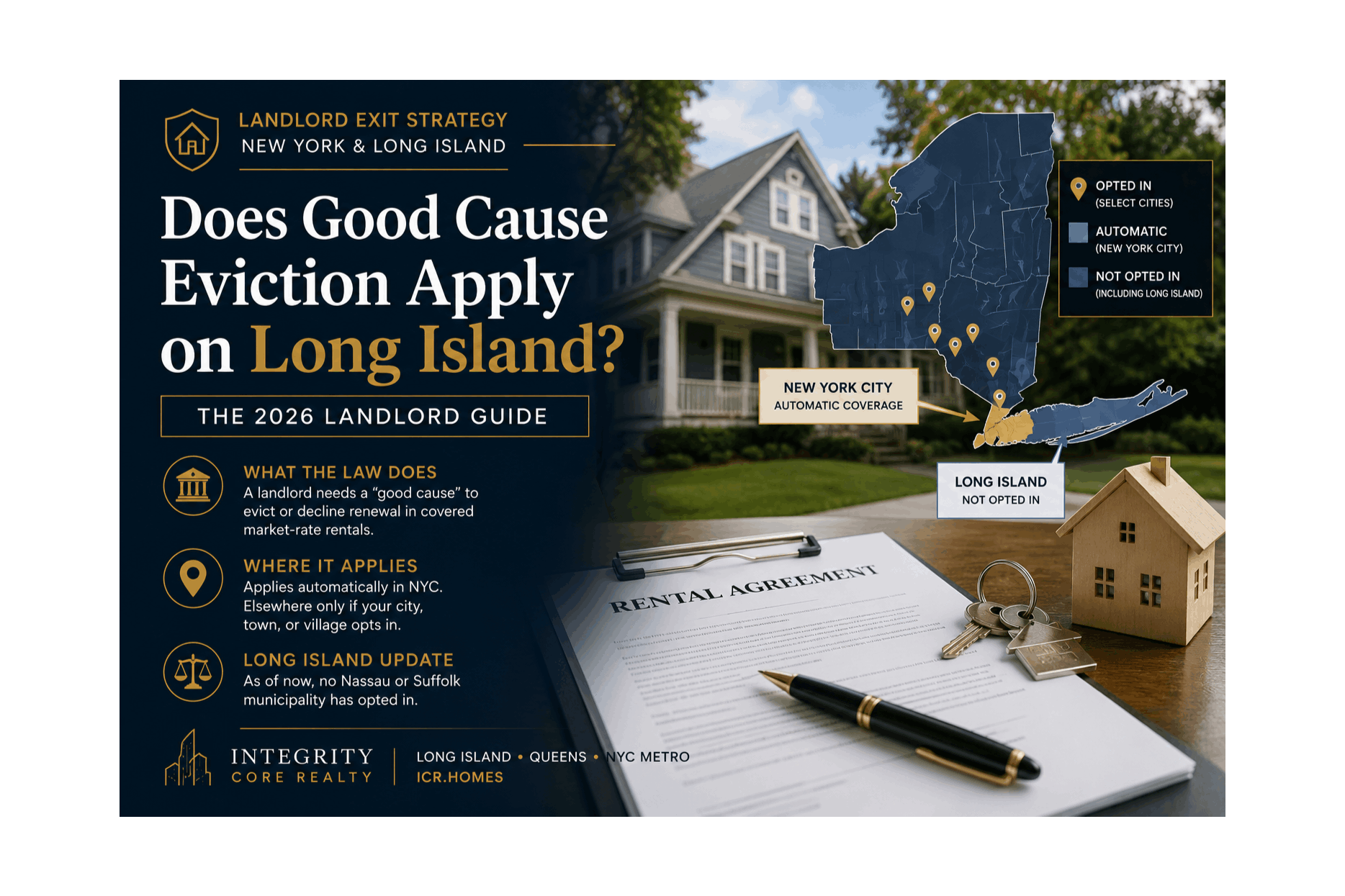
Does Good Cause Eviction Apply on Long Island? The 2026 Landlord Guide
New York's Good Cause Eviction law has landlords across the state on edge, but what it actually means for you depends entirely on where your property sits. Here's the clear-eyed map: what the law does, where it applies right now, and the question every Long Island landlord should be asking.
Integrity Core Realty | Long Island · Queens · NYC Metro | August 2026 | 8 min read
Few laws have generated more landlord group-chat anxiety than Good Cause Eviction, and few are as widely misunderstood. Some Long Island landlords believe it already governs their rentals. Others assume it never will. Both camps are working from headlines instead of the map, and in this case, the map is everything.
So let's read it properly. What follows is general information, not legal advice, this is an evolving area of law where the details genuinely matter, and your attorney should always have the final word on your specific situation.
What the Law Actually Does
Enacted in April 2024 as part of the state budget, Good Cause Eviction changes the default rules for covered market-rate rentals in two big ways. First, a landlord of a covered unit needs a legally recognized reason, a "good cause" such as nonpayment, lease violations, or the owner taking the unit for personal use, to evict a tenant or decline to renew a lease. The era of simply not renewing at lease end, for any reason or no reason, ends for covered units.
Second, rent increases above an annual benchmark, capped at the lower of 10 percent or local inflation plus 5 percent, with the state publishing updated figures each year, are treated as presumptively unreasonable. A tenant facing eviction for nonpayment after such an increase can challenge it in court, where the landlord must justify the number with factors like market conditions, improvements, or operating costs.
Where It Applies, and Where It Doesn't
Here's the part the headlines skip: the law applies automatically only in New York City. Everywhere else in the state, it applies solely in cities, towns, and villages whose local governments have voted to opt in. The opt-in list has grown steadily, Albany, Rochester, Ithaca, Kingston, Poughkeepsie, Newburgh, Beacon, and a lengthening roster of Hudson Valley communities among them, some with their own adjusted thresholds.
And Long Island? As of this writing, no Nassau or Suffolk municipality has opted in. If your rental sits in Hempstead, Huntington, Islip, Babylon, or anywhere else on the Island, Good Cause Eviction does not currently govern it. That is today's map, and it comes with two significant asterisks.
Asterisk one, and it's a big one: if you're a Long Island resident who owns rental property in Queens, Brooklyn, or anywhere in the five boroughs, those units sit inside the automatic coverage zone and have since April 2024. In our experience, a meaningful share of Island-based landlords hold a two-family in Queens or a walk-up in Brooklyn, and some are operating as if the law doesn't reach them. It does.
Asterisk two: the map can change with a single vote. Any Long Island city, town, or village can adopt the law through its local legislative body, the same mechanism that put those upstate communities on the list. Nothing on the Island has passed as of this writing, but "not currently covered" and "permanently exempt" are very different sentences.
| 2024The year Good Cause Eviction took effect in New York City, coverage there is automatic | 10%The ceiling of the annual rent-increase benchmark for covered units (the lower of 10% or local inflation plus 5%) | 0Long Island municipalities that have opted in as of this writing, a number worth watching, not assuming |
The Exemptions That Matter (Where the Law Applies)
Even inside covered areas, the law carves out significant exemptions under the state's default framework: smaller landlords whose statewide portfolio falls at or under the law's unit threshold, owner-occupied buildings under the size cutoff, newer construction for a defined period after its certificate of occupancy, higher-rent units above a multiple of the local fair market rent, co-ops and condos, and units already covered by rent regulation or subsidy programs, among others. Two cautions: opting-in localities can adjust several of these thresholds, and exemption questions turn on precise facts, portfolio counting across LLCs, for instance, is exactly the kind of detail that belongs in a conversation with your attorney, not a blog's comment section.
What a Long Island Landlord Should Actually Do
First, map your true exposure: list every unit you own and where it sits. Island units, not currently covered. Five-borough units, covered since 2024, and worth an immediate compliance review with your attorney if you haven't done one. Second, watch your local board. Opt-in campaigns start as agenda items and public hearings long before they become law; landlords who follow their town and village meetings are never surprised. Third, and this is where we'll be direct with you: fold this into your hold-or-sell math honestly.
For some landlords, the answer is adapt and hold, professional management, tighter screening, disciplined increases within benchmarks. For others, this law lands on top of a pile that already includes maintenance fatigue, a decade of tenant-protection expansion, and equity that has grown enormously, and it becomes the final input in a decision that was quietly forming anyway. Neither answer is wrong. What's wrong is not doing the math at all.
How We Help · Landlord Exit Strategy
Run the Hold-or-Sell Math With Real Numbers
Whether your property is on the Island or in the boroughs, the decision starts with two figures: what the property is truly worth today, and what holding it will actually cost you going forward. We help landlords across Long Island, Queens, and the NYC metro get both, then exit smoothly and strategically if that's where the math points, including sales with tenants in place. No pressure, no assumptions, just a clear-eyed evaluation.
Get Your Free Property Evaluation →
Integrity Core Realty · (516) 200-1202 · info@icr.homes
"'Not currently covered' and 'permanently exempt' are very different sentences. Smart landlords know which one their town is living in."
Related Article
The bigger picture: why a growing number of NYC and Long Island landlords are choosing this market to exit, and how the smart ones are doing it.
Read: The Long Island Landlord Exit Strategy for 2026 →
Frequently Asked Questions
Does Good Cause Eviction apply on Long Island?
As of this writing, no Nassau or Suffolk County municipality has opted in, so the law does not currently apply to rentals located on Long Island. However, any city, town, or village can adopt it by local vote, so landlords should monitor their local boards and verify current status with an attorney.
I live on Long Island but own a rental in Queens. Am I covered?
Coverage follows the property, not the owner. Rentals located in New York City, including Queens and Brooklyn, have been subject to Good Cause Eviction since April 2024, unless a specific exemption applies. If you own in the five boroughs, review your situation with an attorney.
What does the law require where it applies?
For covered units, landlords need a legally recognized good cause, such as nonpayment, lease violations, or owner use, to evict or decline to renew a lease, and rent increases above an annual benchmark (the lower of 10 percent or local inflation plus 5 percent) are presumptively unreasonable and can be challenged in court.
Are any landlords exempt?
The state framework exempts several categories, including smaller portfolios under the law's unit threshold, owner-occupied buildings under the size cutoff, newer construction for a defined period, higher-rent units above a fair-market-rent multiple, and co-ops and condos, though opting-in localities can adjust certain thresholds. Whether an exemption applies to you depends on precise facts; confirm with an attorney.
Should this law change whether I keep or sell my rental?
It's one input, not the whole answer. The right decision weighs your property's current value, carrying costs, management burden, regulatory exposure by location, and your goals. A professional property evaluation puts a real number at the center of that decision, and we provide them free of charge.
Integrity Core Realty · Landlord Exit Specialists
Know Your Exposure. Know Your Number.
Whether you hold, adapt, or exit, every good decision starts with knowing what your property is worth and what it truly costs to keep. Get a free, no-pressure evaluation from a team that works with landlords every day.
How Integrity Core Realty Can Help You
💔 Divorce Sales 🏚️ Landlord Exit Strategy 🏡 Estate & Probate Sales 📦 Downsizing ⚠️ Pre-Foreclosure Help ✨ Our Story
Disclaimer: This article is for general informational purposes only and does not constitute legal advice. Integrity Core Realty is a licensed real estate brokerage, not a law firm. Good Cause Eviction coverage, thresholds, and exemptions vary by locality, are subject to legislative and regulatory change, and are described here in general terms as understood at the time of publication (August 2026); municipalities may opt in or modify provisions at any time. Landlords and tenants should verify current law and how it applies to their specific circumstances with a qualified attorney. Integrity Core Realty, 100 Jericho Quadrangle, Suite 235, Jericho, NY 11753. Equal Housing Opportunity.
Categories
- All Blogs (64)
- Affordability (3)
- Buying Tips (9)
- Divorce & Real Estate (7)
- Downsizing & Senior Moves (3)
- Equity (3)
- Expired/Withdrawn/Canceled (1)
- Fairhaven Real Estate Stories (3)
- First-Time Buyers (9)
- For Buyers (33)
- For Sellers (21)
- Forecasts (3)
- Home Prices (3)
- Infographics (1)
- Mortgage Rates (2)
- NY/LI Landlord Resources (8)
- Pre-Foreclosure Options (2)
- Probate & Estate Home Sales (5)
- Rent vs. Buy (3)
- ⚖️ For Attorneys (4)
- 🏡 Featured Listings (21)
- 📍 Local Living (24)
- 📅 Open Houses & Events (4)
- 📊 Real Estate Insights (7)
Recent Posts