What Your Rent Buys in Nassau, Suffolk, and Queens
Buyer Resources
What Your Rent Actually Buys in Nassau, Suffolk, and Queens

If you pay rent, you are already making a mortgage payment every month. It just happens to be somebody else's. Here is what that same check buys in each of our three markets, and why the answer catches people off guard.
Integrity Core Realty | Long Island · Queens · NYC Metro | September 2026 | 6 min read
The conversation happens a few times a week, and it always starts the same way.
Somebody is paying $3,200 a month for a place they like well enough. They have been watching rates since 2023, waiting for the number that makes buying feel safe. And the honest thing nobody tells them is that while they waited, they handed a landlord more money than most people put down on a house.
So let's stop talking about rates for a minute and talk about the check you already write.
Ten years of renting at today's number is $440,213, and by year ten you are paying $4,175 a month for the same place. Those are not scare numbers. That is a 3% annual increase, which is normal, not a bad year.
The rate is the smaller number
Buyers have been trained to treat the interest rate as the decision. It isn't. It is one input, and it is the one input you can change later.
A point on the rate moves your payment by a couple hundred dollars a month, and you can refinance it when rates move. Five years of rent moves a six figure number, and it is gone the day you pay it. Only one of those two decisions is permanent.
That is the whole argument, and it holds up whether rates go to 5% or back to 8%.
The same $3,200, three different markets
Here is where it gets interesting for anyone shopping across county lines. We ran the same rent through each of our markets, treating it as the entire housing budget, so the mortgage, the property taxes, the homeowners insurance, and mortgage insurance all have to fit inside $3,200 before a single dollar counts as buying power.
| Market | Effective tax | What $3,200 buys | Cash to close |
|---|---|---|---|
| Queens | 0.90% | $434,826 | $56,527 |
| Nassau County | 1.79% | $393,200 | $51,116 |
| Suffolk County | 2.42% | $368,247 | $47,872 |
Single family, 10% down, 6.76% on a 30 year fixed, $1,844 a year for homeowners insurance, and 3% of the price for closing costs.
Same rent. A $66,579 swing in what you can buy, driven almost entirely by the tax rate. Suffolk's 2.42% eats roughly $743 a month at that price, which is why the identical payment buys less house out east even though the sticker prices are lower.
This is the part a mortgage calculator on a national website will never tell you, because most of them leave property taxes out entirely and hand you a flattering number that falls apart at the closing table.
Co-ops and condos change the math completely
If you are looking in Queens or Brooklyn, the house number above is only half the story, because most of what you will tour is attached. And co-ops and condos work in ways that trip up even experienced buyers.
A co-op's maintenance already includes the building's property taxes. The corporation gets one tax bill for the whole building and your share is baked into your monthly maintenance. You never see a separate tax bill. A condo's common charges do not. You get your own bill from the city, on top of the common charge.
Which means comparing a $950 co-op maintenance to a $450 condo common charge is comparing two entirely different things. Watch what happens at the same $3,200 rent:
- Queens condo, $450 common charges, 10% down: about $385,391, and you need roughly $50,101 in cash.
- Queens co-op, $950 maintenance, 20% down: about $425,162, and you need roughly $93,536 in cash.
The co-op carries more than double the monthly charge and still buys $39,771 more, because that maintenance is covering taxes the condo owner pays separately. The tradeoff is cash. Co-op boards typically want 20% down or more, and every purchase needs board approval.
There is one piece of good news on the co-op side that almost nobody mentions. Because no deed changes hands, New York's mortgage recording tax never triggers, so co-op closing costs run closer to 2% instead of 3% or more. On a $425,000 purchase that is thousands of dollars you simply do not pay.
Run your own rent, not ours
Every number above came out of our Rent Check calculator. Put in what you actually pay, pick your market, choose house, condo, or co-op, and it works backward to a purchase price, a five year comparison, and the cash you would need to close. It takes about twenty seconds and nothing is saved.
Open the Rent Check calculatorPart of a mortgage comes back. Rent never does.
Here is the piece the rent versus buy debate usually fumbles. Interest, taxes, insurance, and maintenance are the cost of living somewhere, the same way rent is. But principal is not a cost. It is you moving money from one pocket to another, automatically, every month.
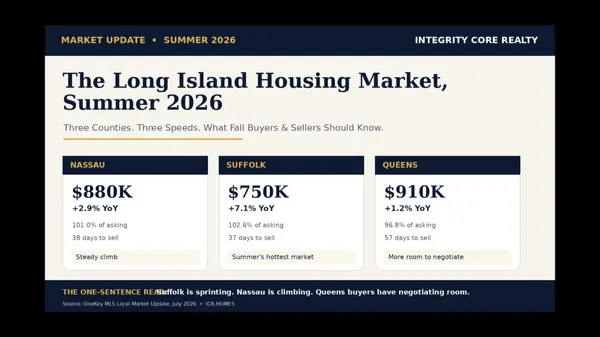
On that Nassau purchase, five years of payments knocks $21,636 off the loan. You spent it, and you still have it. Add what the home does over that stretch and the gap widens. Nassau's median sale price hit $835,000 in January 2026, up 3.1% over the year. Suffolk ran 4.5%. Queens moved fastest of all, up 7.1% to a $750,000 median by August 2026.
Nobody knows what values do next. What we do know is what five years of rent costs, because that part is already decided.
We are not going to tell you appreciation is guaranteed, because it isn't. Values fall as well as rise, and a mortgage magnifies the move in both directions. That is exactly why the calculator lets you set growth to zero and see whether the math still works. For most renters, it does.
The real obstacle is cash, and it has a solution
Run enough of these and a pattern shows up fast. The monthly payment usually already works. What stops people is the pile of cash needed to reach the closing table, somewhere between $47,000 and $57,000 in the examples above.
That is a real number, and it is also a different kind of problem than "I can't afford a house." One is a wall. The other is a savings plan, a gift letter, a 401(k) loan, or a down payment assistance program you did not know you qualified for. New York runs several, and some are open to buyers who are not first timers.
Knowing the number is the entire point. You cannot save toward a target you have never calculated.
Related resource
Renting vs Owning on Long Island: What Your Rent Could Actually Buy
The full calculator, plus the assumptions behind every figure in this article.
Frequently Asked Questions
Why does the same rent buy more house in Queens than in Suffolk?
Property taxes. Queens runs near 0.90% of value while Suffolk runs near 2.42%, and taxes sit inside your monthly payment. At these prices that difference is worth roughly $600 a month, which converts into tens of thousands of dollars of purchase price. Sticker prices are lower in Suffolk, but the carrying cost is higher.
Is a co-op cheaper than a condo?
Monthly, often yes, because the maintenance covers the property taxes a condo owner pays separately. Up front, usually no, since boards commonly require 20% down or more. Co-op closing costs do run lower, because no deed is recorded and New York's mortgage recording tax does not apply. Which one wins depends on whether your constraint is monthly cash flow or money in the bank.
Should I wait for interest rates to come down?
Nobody can tell you where rates go, and anyone who claims otherwise is guessing. What is knowable is the cost of waiting: another year at $3,200 is $38,400 gone. It is also worth remembering that when rates fall, buyer competition tends to rise and prices often follow, so a lower rate does not automatically mean a lower payment. A rate can be refinanced. A year of rent cannot.
How much cash do I really need to close in New York?
Your down payment plus roughly 3% of the purchase price in closing costs, a figure driven higher than most states by New York's mortgage recording tax. On a $400,000 purchase that is about $12,000 on top of the down payment. Co-ops are the exception and run closer to 2%. Ask about down payment assistance before you assume the number is out of reach.
Are these figures a pre-approval?
No. They are estimates built from county averages and today's typical rate. Your actual number depends on your credit, your existing debts, and the specific tax bill on a specific property, which can vary widely inside the same town. Use this to aim, then get a real pre-approval from a licensed lender before you shop.
Find out what your rent is worth
Run your number in twenty seconds, then let's turn it into something you can actually shop with.
Open the calculator Talk to usHow Integrity Core Realty Can Help You
Disclaimer: All figures in this article are estimates for general informational purposes only. They are not a mortgage pre-approval, a loan commitment, or an offer of credit, and Integrity Core Realty is not a mortgage lender, a tax advisor, or a financial advisor. Interest rates, property tax rates, insurance premiums, co-op and condo charges, and closing costs vary by property, by municipality, and by borrower, and they change over time. Past price growth does not predict future results, and property values can decline. Consult a licensed lender, attorney, and tax professional before making any purchase decision. Integrity Core Realty is an Equal Housing Opportunity brokerage.
Categories
- All Blogs (63)
- Affordability (3)
- Buying Tips (9)
- Divorce & Real Estate (7)
- Downsizing & Senior Moves (3)
- Equity (3)
- Expired/Withdrawn/Canceled (1)
- Fairhaven Real Estate Stories (3)
- First-Time Buyers (8)
- For Buyers (32)
- For Sellers (21)
- Forecasts (3)
- Home Prices (3)
- Infographics (1)
- Mortgage Rates (2)
- NY/LI Landlord Resources (8)
- Pre-Foreclosure Options (2)
- Probate & Estate Home Sales (5)
- Rent vs. Buy (3)
- ⚖️ For Attorneys (4)
- 🏡 Featured Listings (20)
- 📍 Local Living (23)
- 📅 Open Houses & Events (3)
- 📊 Real Estate Insights (7)
Recent Posts