Why NYC & Long Island Landlords Are Selling in 2026 | Integrity Core Realty
Why NYC & Long Island Landlords Are Selling in 2026 — And How to Exit Smart
The rules changed. The market surged. For a lot of NYC & Long Island landlords, the math no longer works — and the exit opportunity has never been better.
You bought the property to build wealth. Maybe it was a two-family in Nassau County, a condo in Queens, a rental near the shore. For years it worked — the rent covered the mortgage, the value crept up, and the income was steady enough to make it worth the headaches.
But something shifted. The short-term rental income dried up overnight. The laws got more tenant-friendly — and more complicated. A repair turned into a $15,000 surprise. And somewhere along the way, you stopped asking "how's the rental doing?" and started asking "is this still worth it?"
For a growing number of Long Island landlords, the answer is becoming clear. Three forces are converging at once — and together they're creating one of the strongest exit opportunities the market has seen in years.
"The rules changed, the costs went up, and the home you bought for $380,000 is now worth $620,000. Sometimes the smartest investment move is knowing when to take the gain."
The Airbnb Shift That Changed the Math
In September 2023, New York City's Local Law 18 went into full effect — and it effectively ended short-term rentals as most investors knew them. The law requires hosts to register with the city, be physically present during any rental, and limits guests to two per unit. The practical result: platforms like Airbnb and Vrbo pulled thousands of NYC listings almost immediately.
The ripple hit Long Island fast. Many towns and villages across Nassau and Suffolk counties — already watching the NYC situation closely — began tightening their own short-term rental regulations. Permit requirements, occupancy limits, noise ordinances, and outright zoning bans on rentals under 30 days started appearing across the Island.
For landlords who had built their financial model around short-term rental premiums — summer weekends in the Hamptons, holiday weekends near the water, flexible monthly income in desirable communities — the income floor dropped overnight. Properties that were generating $4,000–$6,000 a month on Airbnb suddenly needed long-term tenants at half that rate, or sat vacant.
Short-Term Rental Restrictions Spreading Across Long Island
• Many Long Island towns now require STR permits with annual fees and inspections
• Minimum rental periods of 30 days increasingly common in residential zones
• Fines for violations can run $1,000–$5,000 per incident in some municipalities
• Platforms must verify host registration before listing — removing non-compliant properties automatically
• The regulatory trend is tightening, not relaxing — more restrictions are expected, not fewer
New York's Tenant Protection Laws: What Landlords Need to Understand
New York has long been one of the most tenant-protective states in the country — but the past several years have accelerated that shift considerably. For landlords who haven't kept pace with the changes, the legal landscape looks very different than it did even five years ago.
The Housing Stability and Tenant Protection Act (HSTPA)
Passed in 2019, the HSTPA was the most sweeping change to New York landlord-tenant law in decades. It strengthened rent stabilization protections, limited landlords' ability to raise rents between tenants, extended notice periods for lease non-renewals, and made it significantly harder to remove rent-stabilized tenants from occupied units. For market-rate landlords, the indirect effects — tighter courts, slower eviction timelines, stricter procedural requirements — were equally significant.
Good Cause Eviction
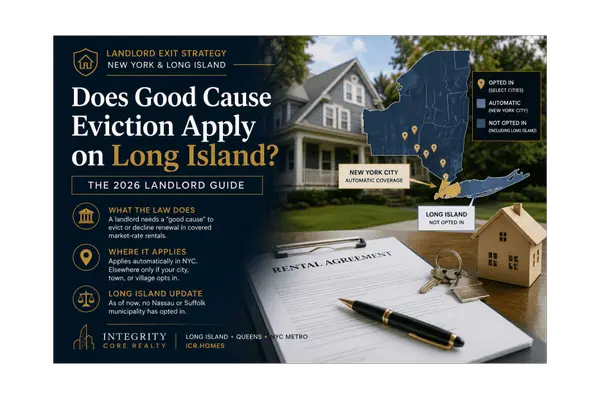
One of the most consequential recent changes is the expansion of Good Cause Eviction protections. Under this framework, landlords in covered municipalities can no longer decline to renew a lease or remove a tenant without a legally recognized reason — non-payment, lease violations, owner occupancy, or substantial building withdrawal from the rental market. Many Long Island municipalities have adopted or are actively considering local Good Cause ordinances, extending these protections beyond NYC's boundaries.
For landlords used to having flexibility at lease end — to re-rent at market rate, renovate between tenants, or simply move on — Good Cause Eviction fundamentally changes that equation.
Eviction Timelines and Court Backlogs
Even in cases where eviction is legally justified, the process in New York has become lengthy and expensive. Housing court backlogs, mandatory pre-filing requirements, and procedural hurdles mean that removing a non-paying or non-compliant tenant can take six months to over a year in some cases. For landlords carrying a mortgage on the property, that exposure is real money.
"New York's tenant protections aren't going away — if anything, they're expanding. For landlords weighing a long-term hold, that legal environment is now part of the cost calculation."
The Equity Opportunity: A Window You Shouldn't Ignore
Here's the part that changes the conversation.
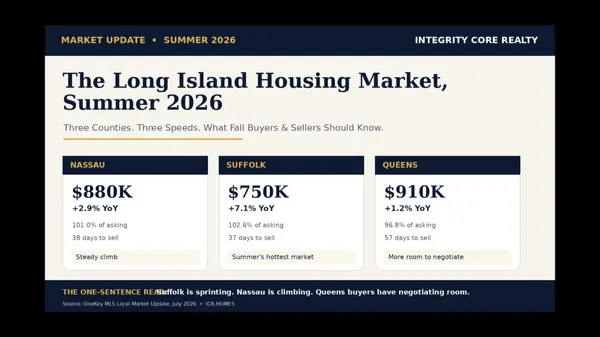
Long Island home values have increased dramatically over the past five years. Nassau County, Suffolk County, and Queens all saw sustained appreciation driven by post-pandemic demand, low inventory, and buyers leaving New York City for more space. Properties that were worth $350,000 in 2019 are commonly listed at $550,000–$650,000 today. Some neighborhoods have seen even sharper gains.
For landlords, this creates a position that is genuinely uncommon: a property whose value has surged, whose carrying costs and legal risks have increased, and whose income potential has been compressed — all at the same time. That's not a reason to panic. It's a reason to evaluate.
The question isn't whether your property has appreciated. It almost certainly has. The question is: what is that equity actually doing for you right now — and what could it do if deployed differently?
Your Options: What a Strategic Exit Actually Looks Like
Selling a rental property isn't just about taking chips off the table. Done correctly, it's a repositioning — turning an asset that's working harder to maintain into capital that can work smarter. Here are the paths most Long Island landlords are evaluating:
How to Exit Your Rental Property the Right Way
A landlord exit isn't something you want to improvise. Here's how a strategic sale comes together:
-
1
Get a Current Market Valuation — Before Anything Else
Most landlords haven't had a professional valuation in years. A Comparative Market Analysis from an experienced agent will show you exactly what your property is worth today — and that number is often the catalyst that starts the conversation in earnest.
-
2
Talk to a Real Estate CPA Before You List
Capital gains tax, depreciation recapture, the New York State capital gains rate — the tax conversation needs to happen before you sign a listing agreement, not after you're under contract. A good CPA can show you your true net and whether a 1031 exchange makes sense.
-
3
Review Your Lease and Tenant's Legal Standing
Know exactly what protections your tenant has, what notice periods are required, and how those facts affect your sale options and timeline. A brief consultation with a New York landlord-tenant attorney is money well spent at this stage.
-
4
Decide Your Path — Occupied Sale vs. Vacant Sale
Work with your agent to evaluate whether selling occupied (investor buyer pool) or vacant (broader buyer pool, potentially higher price) is the right strategy for your specific property, location, and timeline.
-
5
Position and Market the Property Correctly
A rental property needs to be marketed differently than a primary residence. Income history, expense documentation, current lease terms, and cap rate analysis are all part of how an investor buyer evaluates the opportunity. Your agent needs to know how to present that story.
-
6
Close and Execute Your Reinvestment Plan
If you're doing a 1031 exchange, your timeline starts at closing — have your qualified intermediary and replacement property identified in advance. If you're taking the proceeds, have your next financial move mapped out before the check clears.
Frequently Asked Questions
Can I sell my rental property in New York while a tenant is living there?
Yes. In New York you can sell a tenant-occupied property. The tenant's lease must be honored by the new owner — you cannot force a tenant out simply because you are selling. If the tenant is on a month-to-month lease, proper notice is required. If a fixed-term lease is in place, the buyer typically takes the property subject to that lease. An experienced agent can help you position the property to attract buyers comfortable with the tenant situation.
How does New York's Airbnb ban affect landlords on Long Island?
NYC's Local Law 18 (effective September 2023) effectively banned short-term rentals under 30 days unless the host is physically present. Many Long Island towns followed with their own short-term rental restrictions and permit requirements. Landlords who relied on Airbnb-style income have seen that revenue stream severely reduced or eliminated, fundamentally changing the financial case for holding those properties.
What are the tax implications of selling a rental property in New York?
Selling a rental property typically triggers federal and New York State capital gains taxes, plus depreciation recapture on deductions claimed over the years. A 1031 exchange can defer those taxes by rolling proceeds into a like-kind investment property within a specific timeframe. Consulting a real estate CPA before listing is essential — the tax picture should inform your sale strategy, not surprise you at closing.
What is Good Cause Eviction and how does it affect New York landlords?
New York's Good Cause Eviction law limits a landlord's ability to remove a tenant or decline to renew a lease without a legally recognized reason such as non-payment, property damage, or owner occupancy. Many Long Island municipalities have adopted or are considering similar local protections. For landlords who previously relied on flexibility at lease end, this represents a significant shift in how rental properties can be managed and exited.
Is now a good time to sell a rental property on Long Island?
For many landlords, yes. Home values in Nassau County, Suffolk County, and Queens have appreciated 40–60% over the past five years, creating substantial equity positions. Combined with rising operational costs, stricter tenant protections, and reduced short-term rental income, the financial case for holding has weakened while the exit opportunity has strengthened. A professional market analysis can show you exactly what your property would net today — for many landlords, it's a number that changes the conversation.
Integrity Core Realty — Landlord Exit Specialist
Find Out What Your Rental Property Is Worth Today
We work with Long Island landlords to evaluate their exit options, understand the market, and execute a sale strategy that maximizes their equity position. No pressure — just straight answers.
Legal & Financial Disclaimer: This article is for general informational purposes only and does not constitute legal, tax, or financial advice. New York landlord-tenant laws, tax regulations, and local ordinances change frequently and vary by municipality. Always consult a licensed New York real estate attorney, a qualified CPA, and a licensed real estate professional before making decisions about your investment property.
Categories
- All Blogs (63)
- Affordability (3)
- Buying Tips (9)
- Divorce & Real Estate (7)
- Downsizing & Senior Moves (3)
- Equity (3)
- Expired/Withdrawn/Canceled (1)
- Fairhaven Real Estate Stories (3)
- First-Time Buyers (8)
- For Buyers (32)
- For Sellers (21)
- Forecasts (3)
- Home Prices (3)
- Infographics (1)
- Mortgage Rates (2)
- NY/LI Landlord Resources (8)
- Pre-Foreclosure Options (2)
- Probate & Estate Home Sales (5)
- Rent vs. Buy (3)
- ⚖️ For Attorneys (4)
- 🏡 Featured Listings (20)
- 📍 Local Living (23)
- 📅 Open Houses & Events (3)
- 📊 Real Estate Insights (7)
Recent Posts