Selling a Rental With Tenants Still in It: How a New York Sale Actually Works
Landlord Exit
You do not have to empty the building to sell it. You do have to know what the lease says, who your buyer is, and which of two numbers you are actually comparing.
Short answer: yes, you can sell a rental in New York with a tenant living in it. The lease does not end because the deed changes hands. The buyer steps into your side of that lease and inherits its terms, its end date and its security deposit. What changes is who your buyer is, how showings get scheduled, and which paperwork has to be clean before anyone will sign a contract.
Most landlords who call us have already decided they are done. The decision they are stuck on is narrower: sell it occupied, or spend months and money getting it empty first. That question has a real answer, specific to your building and your lease.
The lease is the asset, and the lease is also the constraint
A tenant-occupied sale is a transfer of two things at once. You are selling real property, and you are assigning a contract. A buyer who wants income is buying both willingly. A buyer who wants to move in is buying the first and tolerating the second only until it expires.
So the first document that matters is not the deed. It is the lease, read closely and in full. What is the end date. Is there a renewal option, and does it renew automatically if nobody says anything. What does it say about the landlord entering the unit, and with how much notice. Was there ever a written amendment, a rent change by text message, or a side agreement about the garage.
If the lease is month to month, or there is no written lease at all, you have more flexibility and less documentation, which is its own problem. A buyer cannot underwrite income they cannot see.
The useful instinct here is to stop thinking like an owner and start thinking like the buyer who is about to read your file. Every gap in the paperwork is a reason for someone to offer less, or to walk at the inspection.
Two buyers, two completely different deals
There are two buyer pools for an occupied property, and they want opposite things.
The investor
An investor wants the tenant to stay. A paying tenant on a documented lease is the product. This buyer will ask for a rent roll, copies of every lease, a payment ledger, the security deposit accounting and the last couple of years of expenses. They will care more about the numbers than the kitchen. They are often less emotional about cosmetic condition, which can save you a prep budget.
What they will not do is pay for a story. If the rent is below what the unit would command today, the investor prices off the rent you are actually collecting, not the rent you believe the unit deserves. In most of these conversations that gap is the single biggest number on the table.
The owner-occupant
A buyer who intends to live there needs the unit empty by closing, or very soon after, and almost always needs it empty to get the financing they are using. This buyer pool is far larger. It is also the pool that cannot close around an occupied unit on a lease with eighteen months left.
That is the whole tension. The larger pool needs vacancy, and vacancy costs money and time and is not always within your control.
Showing access is the part that surprises people
A tenant is not obligated to make your sale convenient. They have a right to quiet enjoyment of the home they are paying for, and access is governed by the lease and by what is reasonable, not by your listing schedule.
In practice that means showings by appointment, with real notice, in windows the tenant has agreed to. No lockbox free-for-all, no Sunday open house with sixty strangers walking through someone else's living room. The listing gets fewer showings than a vacant house would, from buyers serious enough to book.
The good news is that a cooperative tenant is an asset, and cooperation is more available than landlords expect. Most tenants are not hostile. They are anxious. They have heard the house is being sold and have no idea whether they are about to be homeless. A short, plain, written explanation of what is happening, what will not happen, how much notice they will get and who to call changes the temperature of the entire listing. We write that letter on every occupied listing we take, and we send it before the sign goes up.
A cooperative tenant is worth more to your sale than a staged living room.
The paperwork that travels with the building
Three items cause most of the trouble at the closing table on an occupied sale, and all three are fixable months in advance.
The tenant estoppel certificate
A short statement, signed by the tenant, confirming the basic facts of the tenancy: the rent, the term, the deposit held, whether rent is current, and whether the tenant believes the landlord owes them anything. It is not required by statute. It is a diligence practice, and buyers ask for it because it stops a surprise claim after closing. Getting it signed while the relationship is still good is far easier than getting it signed during a dispute.
The security deposit
New York is specific about this one. Under General Obligations Law section 7-105, a landlord who has received a security deposit and then conveys the property must turn the deposit over to the buyer at the delivery of the deed or within five days after, and must notify the tenant by registered or certified mail of the transfer and of the new owner's name and address. Once that is done properly, the seller is relieved of liability for returning it and the buyer becomes responsible. The statute also says that failure to comply is a misdemeanor, and that its provisions do not apply if the agreement between landlord and tenant is inconsistent with them. Your attorney handles the mechanics. Your job is to know where the money is and to have the accounting ready.
The rent roll and the ledger
A one-page rent roll, the signed leases, a payment history, the deposit accounting. If an investor has to reconstruct your income from bank statements, they discount for the uncertainty. This is the cheapest value you will add to the file.
If you decide to deliver it vacant
Sometimes vacant is the right answer. The route there is a legal process with dates attached, not a negotiating posture.
Notice, if you are not renewing
New York Real Property Law section 226-c sets minimum written notice when a landlord does not intend to renew a tenancy, or intends to renew with a rent increase of five percent or more. The required notice is based on the cumulative time the tenant has occupied the unit or the length of the lease term, whichever is longer. Under thirty days' notice applies where the tenant has occupied the unit less than a year and has no lease term of at least a year. Sixty days applies above one year and below two. Ninety days applies at two years or more. The statute also provides that if the landlord fails to give timely notice, the tenancy continues on existing terms until the notice period has run, whatever the lease says. Build the calendar backward from that.
Whether Good Cause Eviction applies to you
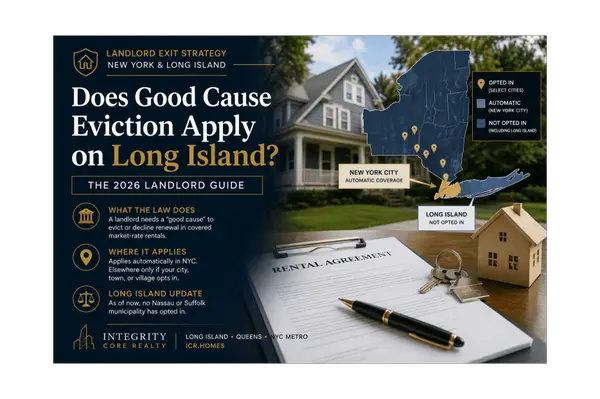
This one is geographic and people get it wrong constantly. New York's Good Cause Eviction law took effect for New York City under Real Property Law section 212. Any other village, town or city has to opt in by passing a local law under section 213, and the state publishes the list of those that have. In the Division of Housing and Community Renewal notice updated May 4, 2026, the municipalities on that list were Albany, Beacon, Binghamton, Hudson, Ithaca, Kingston, Middletown, New Rochelle, Newburgh, Poughkeepsie, Rochester and White Plains, the towns of Fishkill and Poughkeepsie, and the villages of Catskill, Croton-on-Hudson, New Paltz, Nyack and Tarrytown.
Read that list again. No municipality in Nassau County and none in Suffolk County appears on it. A rental in Queens is inside New York City, so the law reaches it. A rental in Hempstead or Islip or Smithtown is not covered unless that municipality has since adopted a local law, which is worth confirming at the time you act rather than taking from any article, including this one. The same notice sets the default coverage ceiling at two hundred forty-five percent of HUD fair market rent, which for Nassau and Suffolk works out to $6,730 a month for a two-bedroom, and for Queens to $7,130.
Cash for keys, and what it really is
A negotiated move-out is the middle path, and in our experience it is the one that works. The owner offers money, time and sometimes moving help in exchange for a signed agreement with a firm surrender date. The tenant gets certainty instead of a notice and a court date. The owner gets a date they can put in a contract.
It is a negotiation, so it can fail, and it has to be voluntary to be worth anything. Nothing about it should look or feel like pressure. Your attorney drafts the agreement. Until one is signed you do not have a vacancy, you have a hope, and you should not promise a buyer a delivery date built on one.
Eviction, last and reluctantly
Housing court is slow, public and expensive, and the clock does not care about your listing. If you are at this point you need a landlord-tenant attorney, not a real estate article. We work alongside the attorney you hire rather than pretending to replace them.
Run both numbers before you decide anything
Here is the exercise we do at the kitchen table.
Start with what vacancy costs. For federal fiscal year 2025, the fair market rent the U.S. Department of Housing and Urban Development publishes for a two-bedroom in Nassau or Suffolk County is $2,747 a month, the figure New York State reproduced in its May 4, 2026 Good Cause Eviction notice. Use your own rent if it differs. Three months of vacancy at that level is $8,241 of rent you do not collect, before the taxes, insurance, utilities and any mortgage payment that keep running anyway.
Then look at how long the sale takes. In OneKey MLS's October 2026 county reports, single-family homes took a median of 44 days on market until sale in Nassau and 43 days in Suffolk. That is list date to accepted offer. Contract, mortgage commitment, title work and closing all come after it. A vacancy window sized to the showing period is sized wrong.
|
44 days
Median days on market until sale, Nassau single-family, October 2026. OneKey MLS.
|
43 days
Median days on market until sale, Suffolk single-family, October 2026. OneKey MLS.
|
$2,747
HUD fair market rent, two-bedroom, Nassau and Suffolk, federal fiscal year 2025, as published by NYS DHCR, May 4, 2026.
|
Scope note: the OneKey county figures above are from the single-family tables of the October 2026 Nassau and Suffolk county reports. Those reports break out condos and co-ops separately, and the numbers differ by property type.
Now the part where we will not give you a number, because no honest source has one. OneKey MLS does not publish a breakdown of sale outcomes by whether the property was occupied or vacant at closing. Neither does anyone else in this market. So any article that tells you an occupied sale costs you a specific percentage is making it up. What we can do is price your building both ways against real comparable sales, show you the two results side by side with the carrying costs and the risk of each attached, and let you pick. Occupied or vacant, we will run both numbers. That is the whole offer.
What we handle on an occupied listing
Reading the lease and flagging the dates that drive the whole timeline before we price anything.
The tenant conversation and the written notice letter, so the first thing your tenant hears is accurate.
Showing protocol: appointment windows the tenant agreed to, and notice every time.
Assembling the file a buyer will ask for: rent roll, leases, ledger, deposit accounting and the estoppel certificate.
Working alongside your attorney on the deposit transfer and the surrender agreement, if there is one. We do not give legal advice and we do not pretend the line is blurry.
One more thing worth saying out loud. If part of why you are selling is that the arithmetic of owning this building stopped working, that is a legitimate reason and not a failure. Our Rent Check tool runs the same comparison a renter runs, in reverse.
Related reading
Frequently asked questions
Can I sell my house in New York if a tenant is living in it?
Yes. The sale does not terminate the lease. The buyer takes the property subject to the existing tenancy and steps into the landlord side of that lease, including its end date and its security deposit. What a sale changes is your buyer pool and your showing logistics, not the tenant's right to be there through the term they signed for.
Does my tenant have to let buyers in to see the unit?
Access is governed by the lease and by what is reasonable, not by your listing calendar. In practice that means appointment showings with real notice in windows the tenant has agreed to, rather than open houses and lockboxes. Expect fewer showings than a vacant property and plan the marketing around that from the start.
What happens to the security deposit when the property sells?
New York General Obligations Law section 7-105 requires the seller to turn the deposit over to the buyer at the delivery of the deed or within five days after, and to notify the tenant by registered or certified mail of the transfer and the new owner's name and address. Once that is done, responsibility for returning the deposit moves to the buyer. Failure to comply is a misdemeanor under the statute. Your attorney handles the mechanics.
Does the Good Cause Eviction law apply to my Long Island rental?
It applies in New York City under Real Property Law section 212, and elsewhere only where a village, town or city has opted in by local law under section 213. In the New York State DHCR notice updated May 4, 2026, no Nassau County or Suffolk County municipality appeared on the opt-in list. A Queens rental is inside New York City and is reached by the law. Confirm the current list and your unit's status with your attorney before you act on it.
Should I sell it occupied or get it empty first?
That depends on your lease, your rent relative to the market, your carrying costs and how much time you are willing to spend. Nobody can answer it from a blog post, and no credible source publishes a figure for what occupancy costs at sale, because the data is not collected that way. The useful step is to have both scenarios priced against real comparable sales with the carrying costs attached, then decide.
How Integrity Core Realty Can Help You
|
Selling a home while a marriage ends, handled with discretion and a steady hand. |
Occupied or vacant, we run both numbers before you decide. |
|
We handle the house so you can handle everything else, alongside your attorney. |
Plan the sale and the next purchase together so both moves line up. |
|
Options explored early, while there are still options to explore. |
Why Integrity Core Realty was built, and who we built it for. |
Disclaimer: Integrity Core Realty is a licensed real estate brokerage. We are not a lender, a law firm, a title company or a tax advisor, and nothing on this page is legal, tax or lending advice, a loan pre-approval or a promise of credit. Market figures are point-in-time readings from the sources named in the article and change with every reporting period. Verify anything you plan to rely on with your attorney, your accountant and your lender. Landlord and tenant law in New York is specific, local and subject to change. The statutes and the state agency list described here were checked against primary sources on November 22, 2026 and should be reverified before you rely on them. Nothing here is a substitute for a landlord-tenant attorney. Integrity Core Realty, 100 Jericho Quadrangle Suite 235, Jericho NY 11753. (516) 200-1202. info@icr.homes. icr.homes. Equal Housing Opportunity.
Categories
- All Blogs (68)
- Affordability (3)
- Buying Tips (9)
- Divorce & Real Estate (8)
- Downsizing & Senior Moves (3)
- Equity (3)
- Expired/Withdrawn/Canceled (1)
- Fairhaven Real Estate Stories (3)
- First-Time Buyers (9)
- For Buyers (35)
- For Sellers (22)
- Forecasts (3)
- Home Prices (4)
- Infographics (1)
- Mortgage Rates (2)
- NY/LI Landlord Resources (9)
- Pre-Foreclosure Options (2)
- Probate & Estate Home Sales (5)
- Rent vs. Buy (3)
- ⚖️ For Attorneys (6)
- 🏡 Featured Listings (21)
- 📍 Local Living (25)
- 📅 Open Houses & Events (4)
- 📊 Real Estate Insights (8)
Recent Posts